After you have sat with enough complaint files, you stop calling them exceptions.
Press Ganey's State of Healthcare Safety 2026, released in March, puts a name on something advocacy teams have been seeing in the queue for years. Not a staffing story. Not a bad-night story. A structural one.
The report describes a three-shift reality, where days, nights, and weekends operate under different conditions. Nearly half of healthcare employees report low perceptions of safety culture, and the gap widens on nights and weekends.
For anyone reading a complaint queue closely, that finding is not news. It is a validation.
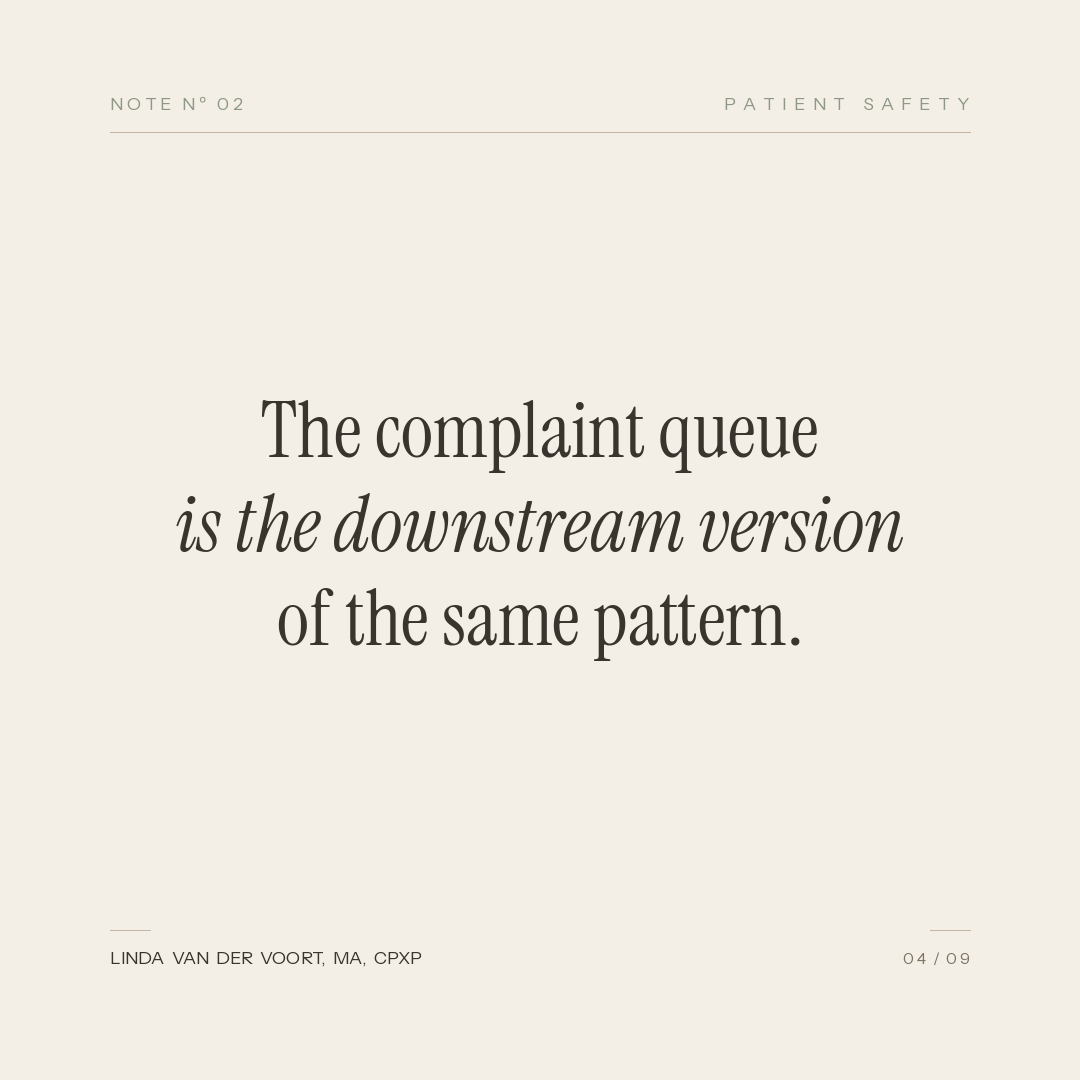
The complaint queue is the downstream version of the same pattern.
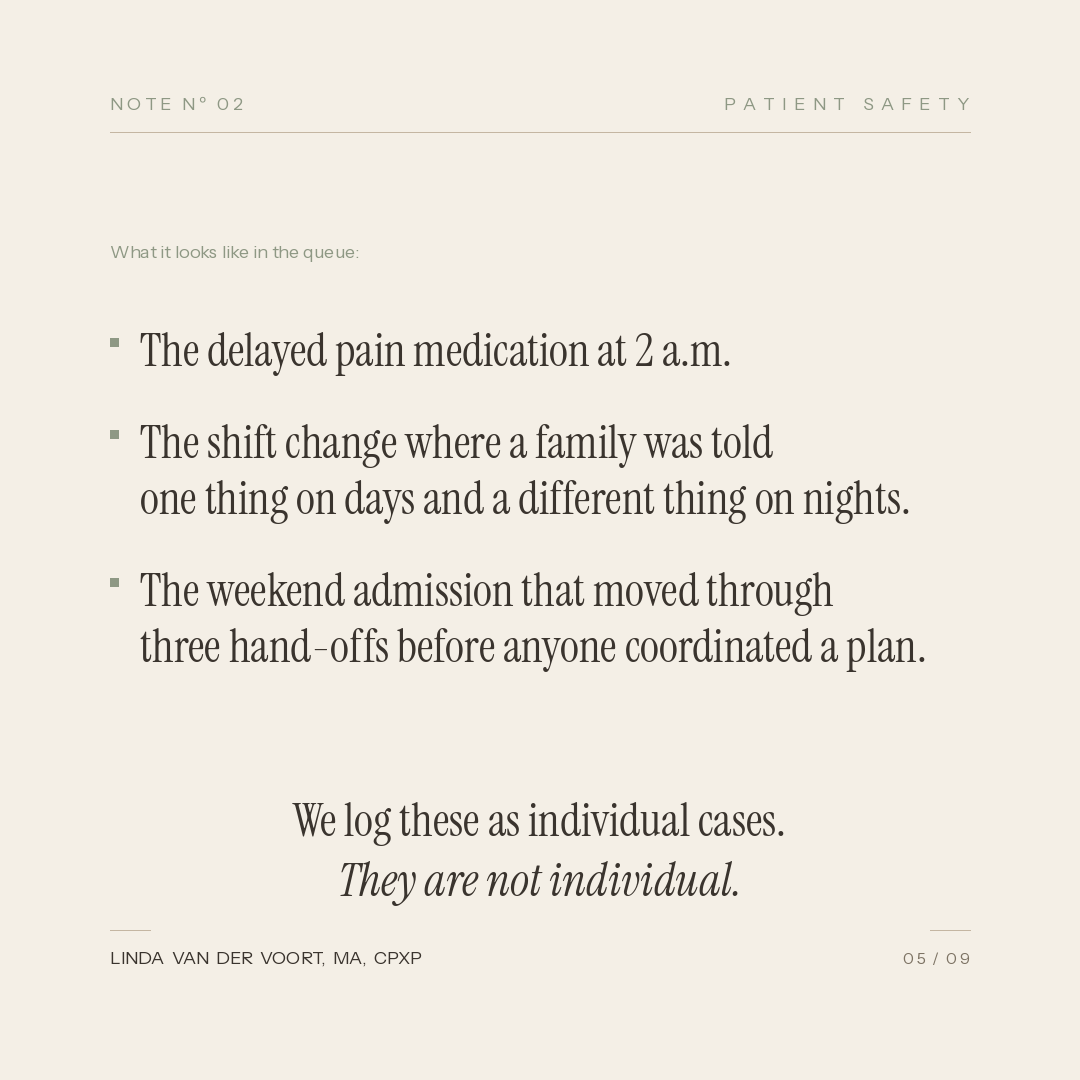
What it looks like in the queue
Experience and advocacy leaders see it every week. The delayed pain medication at 2 a.m. The shift change where a family was told one thing on days and a different thing on nights. The weekend admission that moved through three hand-offs and a covering attending before anyone coordinated a plan.
We log these as individual cases. They are not individual. They are the same structural condition expressing itself through different patients, at different hours, on different units. The file looks anecdotal because we opened it one file at a time.
The reframe
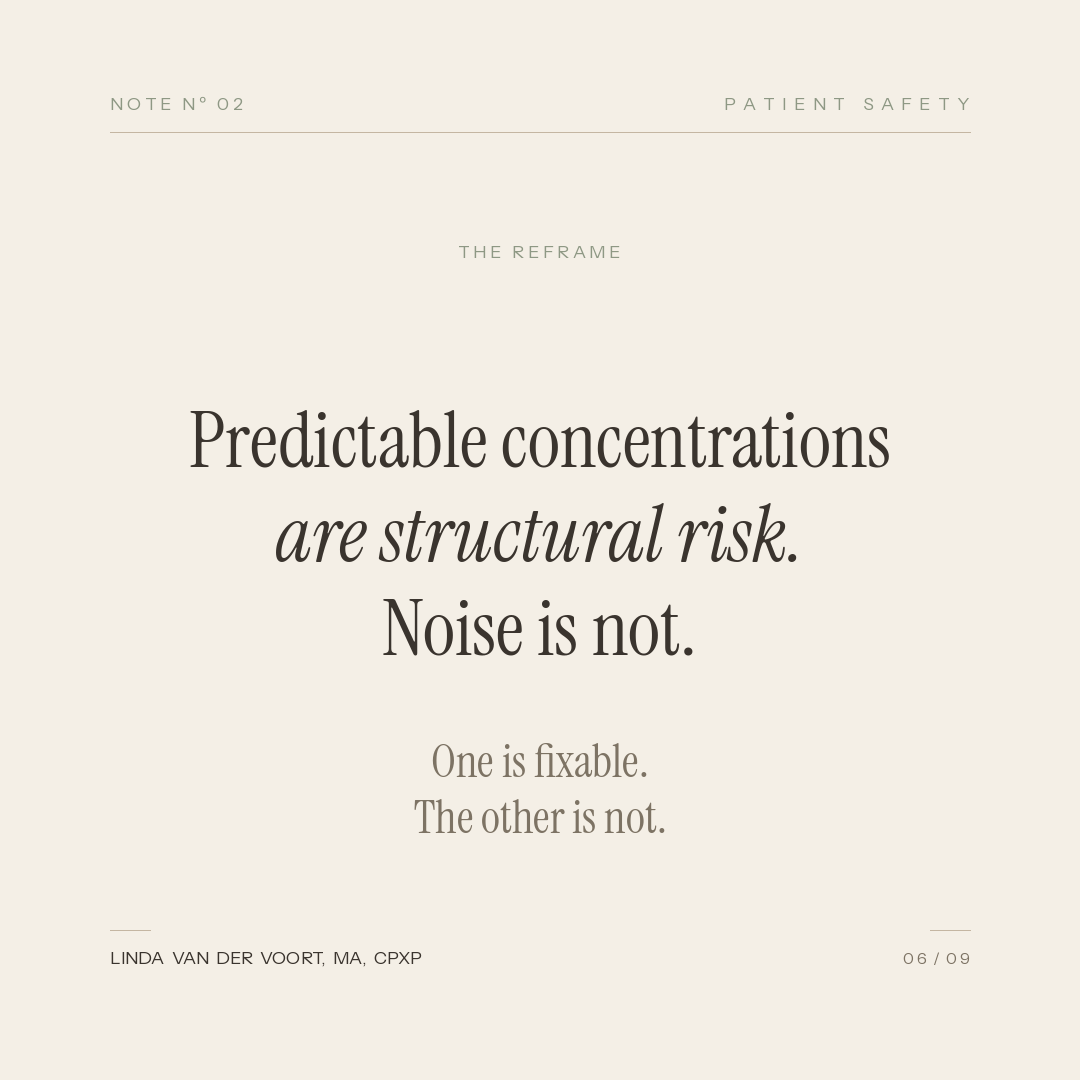
If you sorted ninety days of complaints by shift of onset, then by unit, you would not find noise. You would find predictable concentrations.
Predictable concentrations are structural risk. Structural risk is fixable. Noise is not.
Most patient experience and patient relations teams are measured on aggregate numbers, closure timelines, and HCAHPS score movement. Those are real measures. But they do not tell you which shift on which unit is consistently generating the cases that make it into the queue in the first place. To see that, you have to ask the data a slightly different question.
The discipline
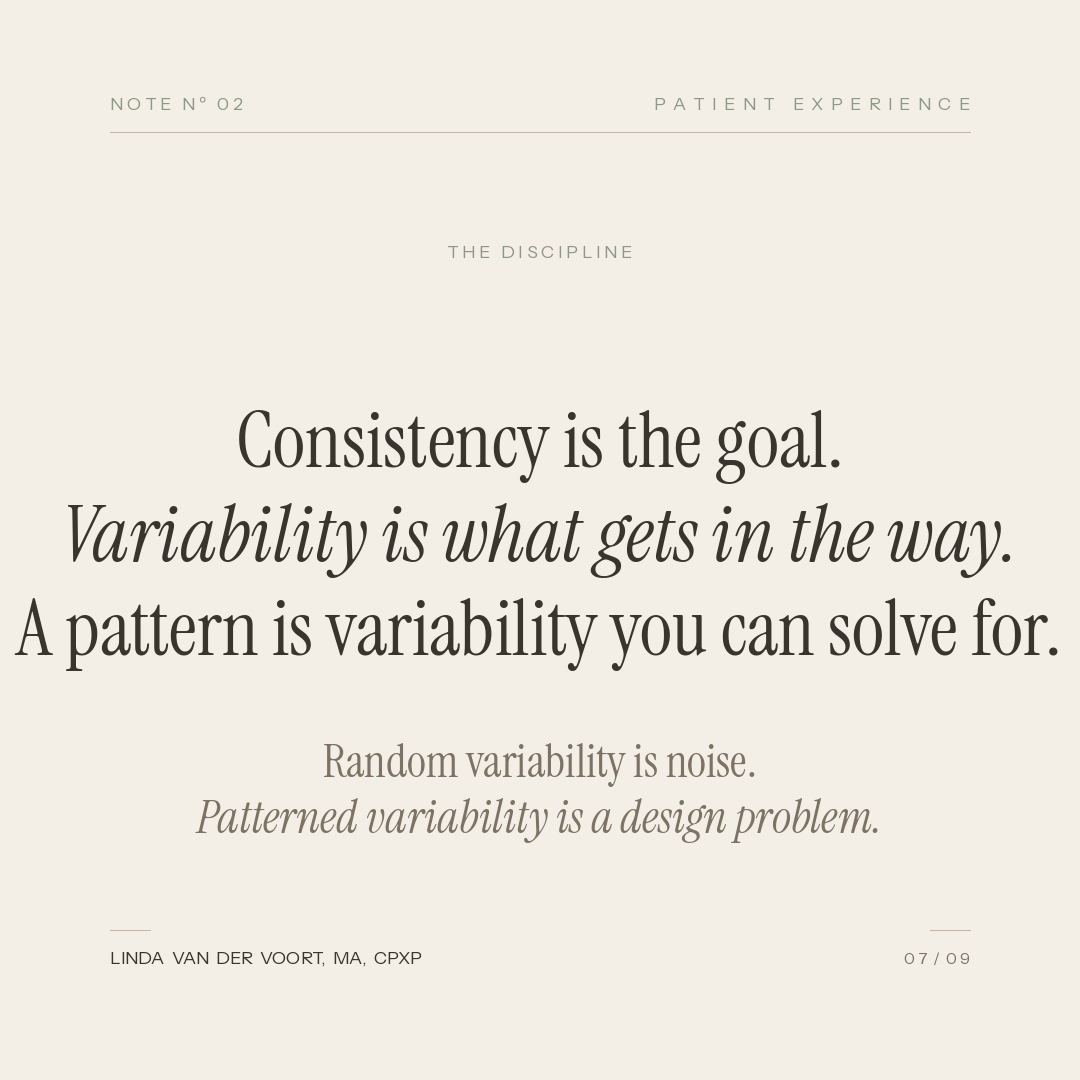
Consistency is what great patient experience is built on. It is the work.
Variability is what gets in the way of it. The useful distinction, and the one most teams never get to, is between random variability and patterned variability. Random variability is noise. You cannot fix noise. You can only absorb it. Patterned variability, on the other hand, is a design problem. It has a location, a shape, a shift, a unit. You can hand it to operations and ask for a schedule adjustment, a staffing model rethink, a communication handoff redesign.
A three-shift gap is not noise. It is patterned variability. It is the rare kind of variability you can actually solve for.
The lever most teams do not pull
The team closest to the lived experience has field-level evidence of when and where the care model strains. That evidence is not stored in any dashboard. It is stored in the complaint files. And in most systems it never gets read as a system-level signal, only as individual cases to close.
When you aggregate it, you can hand it to safety and operations in a form that points to a schedule, not a person. That framing matters. A schedule problem is a reliability problem, and a reliability problem is something a hospital knows how to fix. A person problem is a discipline problem, and discipline problems do not get fixed. They get managed around, usually badly.
Reframing from person to schedule is the most consequential thing an experience or advocacy team can do with its own data.
The ninety-day exercise
If you want to see whether this applies to your system, try this. It takes an afternoon, not a quarter.
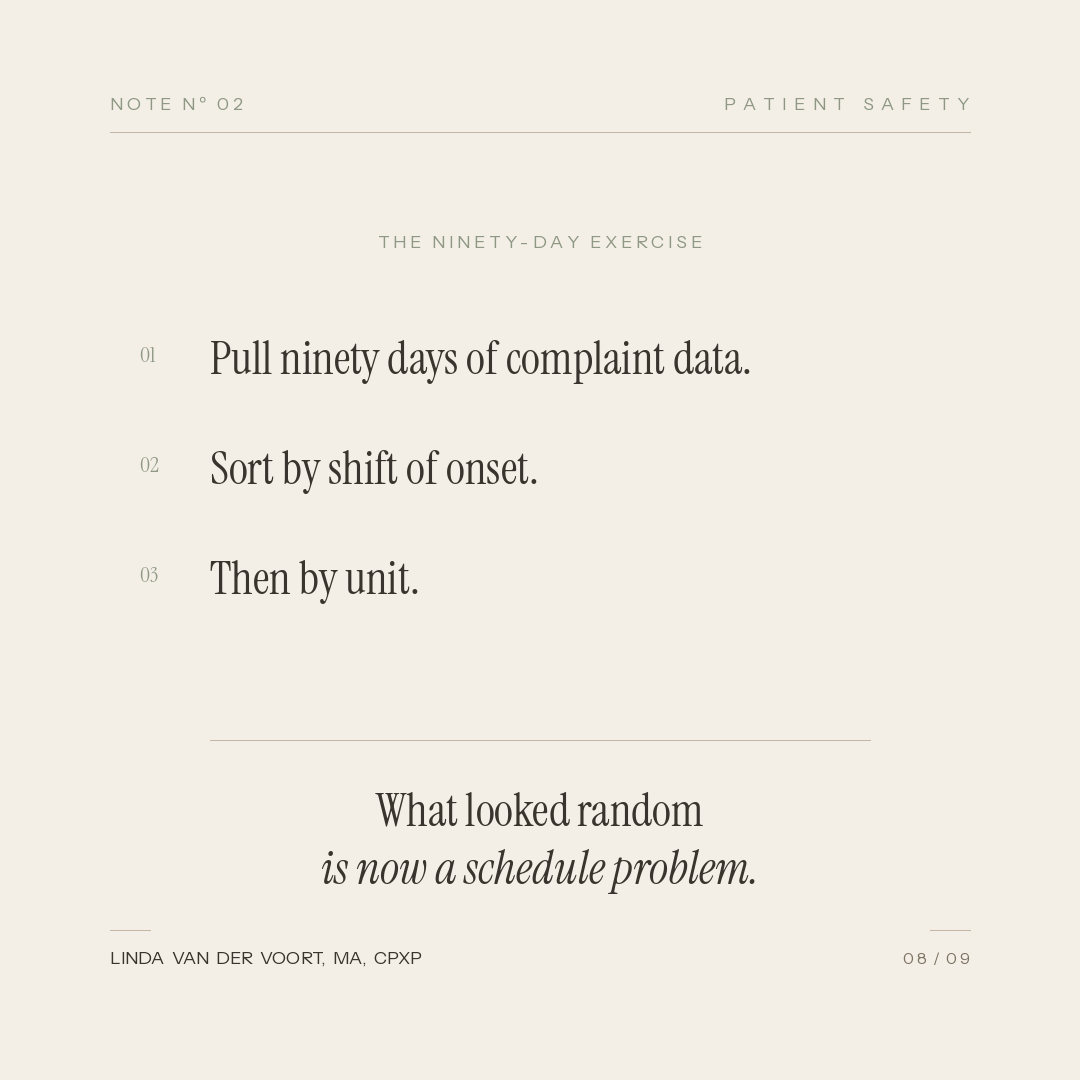
Pull the last ninety days of complaint or grievance data. Add one column: shift of onset. Days, evenings, nights, weekends. Use the definitions your system already uses for operational purposes. Then sort by shift of onset, then by unit within shift. Look at the concentrations.
Do not look for a case type. Look for where the cases are accumulating. The shapes you see are the shapes your organization's care delivery is making under different conditions.
If you find nothing, you have ninety days of data that says your system is performing consistently across conditions. That is genuinely useful information, and rare.
If you find something, which is what happens most of the time, you now have a tool. You can hand your findings to safety, operations, and nursing leadership with a specific ask. A communication redesign on nights. A staffing review on weekend admissions. A hand-off checklist on covering-attending transitions. Whatever the pattern is pointing at.
What looked random is now a schedule problem.
The bigger argument
HCAHPS response rates have drifted into the 25 to 30 percent band with a decline since 2020, and the mode mix is increasingly web-first. Year-over-year comparisons are getting harder to trust. Meanwhile the complaint and grievance channel is a more patient-initiated signal than HCAHPS has ever been. People file complaints because something happened to them. That is different from a sampled survey.
If you are a patient experience or patient relations leader sitting at a table where HCAHPS is the primary narrative, the complaint queue is a parallel, patient-initiated, structurally-informative dataset you already own. You do not need a vendor to read it. You need ninety days and one added column.
That is the argument. Consistency is the goal. Variability is what gets in the way. Patterned variability is a design problem, and the people closest to the lived experience are the best positioned to find it.
Visual guide
Building the operational scaffolding to act on patterns like this? The Escalation and Workflow Toolkit includes regulatory grounding against 42 CFR 482.13(a)(2), a dual-reviewer ladder from Day 0 through Day 7, an after-hours protocol, and service recovery scripts.
View the ToolkitNot sure where your department stands?
Take the Free 10-Point Audit